Learn about some of the reasonable adjustments that can be made in a wide range of health, care and other settings.
Reasonable adjustments are changes made to help people with disabilities or specific needs take part fully in activities, services, or workplaces.
These adjustments make sure everyone has the same opportunities.
Here are some examples:
Physical changes: Adding ramps or handrails to make buildings easier to enter.
Communication help: Providing materials in Braille or large print or having sign language interpreters.
Flexible rules: Allowing changes in work hours or deadlines for medical appointments.
Extra support: Offering help like personal assistants or special training.
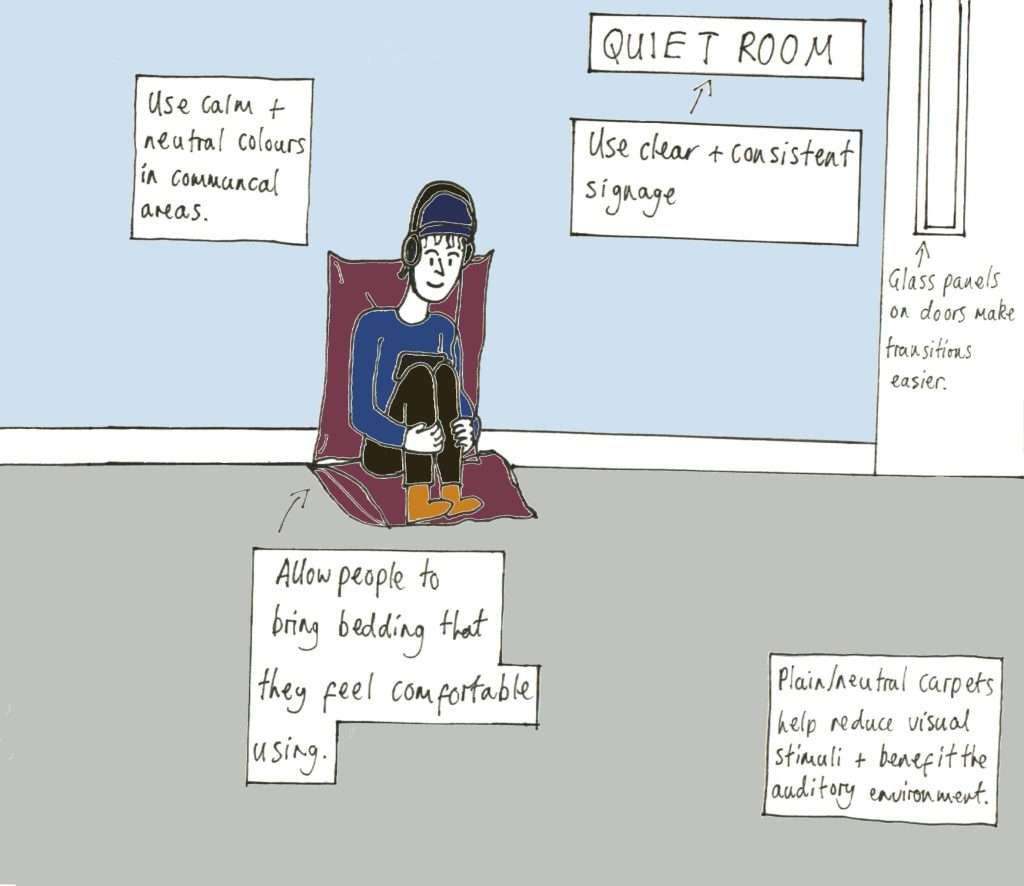
Illustration of a person sitting on a cushion on the floor. There is an arrow pointing to the person with the words 'Allow people to bring bedding that they feel comfortable using'. There is a sign above which says 'quiet room'. An arrow points to this with the words Use clear + consistent signage. On the other side are the words 'Use calm + neutral colours in communal areas'. In the bottom corner are the words 'Plain/neutral carpets help reduce visual stimuli + benefit the auditory environment'. At the far right is a window. An arrow pointing to the window says 'Glass panels on doors make transitions easier'.
Employers and services are required by law to make reasonable adjustments (Equality Act 2010). The goal is to create an inclusive environment where everyone can thrive.
Here are two C(E)TR panel members talking about reasonable adjustments in more detail.